

The Content Scaling Paradox: Why More Content Delivers Less Visibility in 2026
16 Mar 2026 | Performance Marketing

5 Mins
SHARE


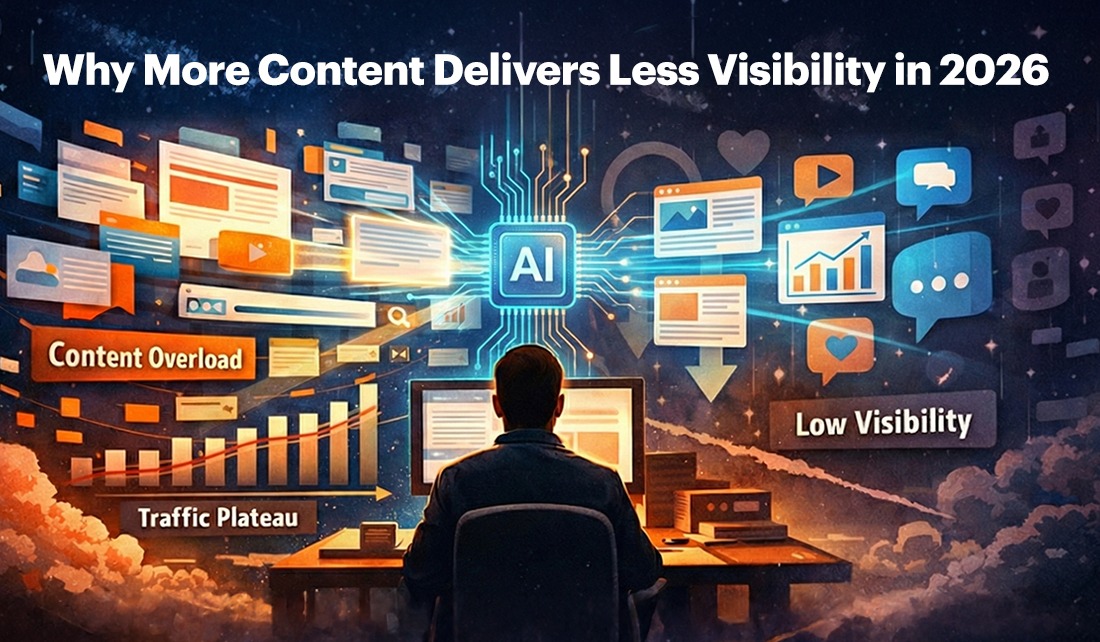
Not long ago, content scaling felt straight forward. Publish more consistently, cover more keywords, and visibility would follow. In 2026, many marketers are doing all of that and still feeling stuck. Traffic plateaus, engagement feels shallow, and search visibility does not grow in proportion to effort.
This is the content scaling paradox. You are producing more content than ever, yet it feels harder to be seen, remembered, or chosen. The issue is not effort. It is that the way content is discovered and evaluated has changed.
So, what’s actually changing across search and social, and how should marketers adapt for better AI-era search visibility?
Problem #1: AI is selecting what gets seen before humans do
In 2026, search is no longer just a list of links. AI-generated summaries and preview answers increasingly appear at the top of results and often satisfy user intent without a click. This shifts visibility from ranking alone to being selected as a trusted source.
What this means in practice is that long articles packed with keywords may never be fully read, even if they rank. The parts that matter most are the sections that AI systems can easily understand and extract.
You can see this clearly with brands like HubSpot, which now structure most long-form content with early summaries, expandable FAQs, and tightly scoped answer sections that can be pulled into AI summaries without losing context.
What to do now
- Create clearly structured response blocks at the top of articles that directly answer specific user questions
- Use FAQ sections with concise, direct answers
- Implement schema markup to help search engines understand your content’s semantic meaning
Pointers for action
- Write a crisp summary at the top of every piece (two sentences that can be pulled as an answer)
- Add FAQs with clear Q&A pairs
- Use structured data for articles and FAQ pages
Problem #2: Social platforms now act like search engines
Discovery is no longer owned by search alone. Platforms like Instagram and LinkedIn are increasingly used to look up products, ideas, and opinions. Their algorithms reward depth of engagement rather than posting frequency.
Instagram updates in 2025 shifted emphasis toward completion rates, saves, and meaningful shares, making shallow high-volume posting less effective. LinkedIn has also evolved. Its 2025 updates favour thoughtful interactions and conversation depth, which affects how scaled content performs in professional feeds.
What to do now
- Build content that invites interaction, not just consumption
- Use short, reusable modular formats (snackable text + short clips + carousel bites)
- Map platform behaviors before scaling posting frequency
Pointers for action
- Start every post with a question or hook that invites a reply
- Add at least one interactive prompt per piece (poll, ask for comment, share to save)
- Reuse long-form content in multiple shorter formats (clips, quote cards, carousel slides)
Problem #3: Automation amplifies weak signals
Automation tools promise easier scaling, but they only work as well as the signals they receive. Platforms increasingly rely on engagement patterns, behavioural context, and content relevance to decide what to show.
Industry research shows that automation favors content with clear audience signals and consistent performance indicators.
If content is scaled without understanding what resonates, automation simply spreads underperforming material faster.
You can see the opposite approach with Canva, which tests small content blocks, identifies patterns that hold attention, and then scales those exact formats across channels.
What to do now
- Focus on engagement quality metrics, not just output
- Track exploration behaviors (scroll depth, average view time, share rate)
- Use modular content patterns that let audiences pick up where they left off
Pointers for action
- Tag content with audience intent types (learn, compare, decide)
- Pair analytics with content mapping so the system knows what “good” looks like
- Test modular blocks of content to find what resonates, then scale using those patterns
Problem #4: Top-of-funnel traffic is drying up
As AI summaries answer questions directly, fewer users click through during early research stages. This reduces traditional top-of-funnel traffic and makes volume-based scaling less effective.
Search Engine Land notes that AI-driven result formats increasingly satisfy intent within the interface itself.
This is why brands like Shopify now publish concise explainer content that is designed to be quoted, summarized, and referenced, not just clicked.
What to do now
- Build answer-first content that matches AI interface expectations
- Combine that with strategic amplification (RSS syndication, short-form summaries on social, internal linking structures)
Pointers for action
- Turn sections of long-form content into standalone summaries that feed into answers
- Create distinct answer assets targeted at specific questions
- Track AI referrals as a separate metric
Framing a better way to scale
Here is a distilled checklist based on 2025–2026 platform realities that help with content scaling and AI-era search visibility:
- Start with audience intent maps, not keyword lists
- Structure content for AI and search outcome snippets (answer blocks)
- Reformat assets into reusable modular pieces for multi-channel discovery
- Track engagement signals, not just publishing counts
- Use schema and structured data everywhere to help platforms index semantically
- Loop engagement behavior back into your scaling strategy, so you scale what works
This is not about output. It is about visibility design.
Wrap up
The content scaling paradox exists because discovery has changed faster than strategy. In 2026, visibility depends on structure, intent, and signal quality as much as creativity.
If you want to scale content in a way that improves AI-era search visibility and drives impact, it is time to rethink how your system works.
Partner with us or check out our services to build a content-at-scale strategy designed for how platforms work today.
Other Posts
3 PPC Myths Holding You Back in 2026 (And What Works Instead)
Paid search isn’t dying; it’s evolving. Between AI taking a central role, privacy changes reshaping targeting, and AI Overviews shifting where people click (or don’t), PPC has a new...
A New Dawn: Meta Andromeda’s Impact on Ad Strategy
For years, Meta advertising followed rules. Define the audience. Set the targeting. Test a few ads. Optimise. That logic no longer holds. Meta has quietly shifted from rule-based delivery to AI-first decision-making. At the...
What is AIO? The Beginner’s Guide to Artificial Intelligence Optimisation
Once upon a time, ranking on Google was every brand’s digital checklist. But the world has , and so have our search habits. Today, people don’t just search; they...