

 Blo
Blo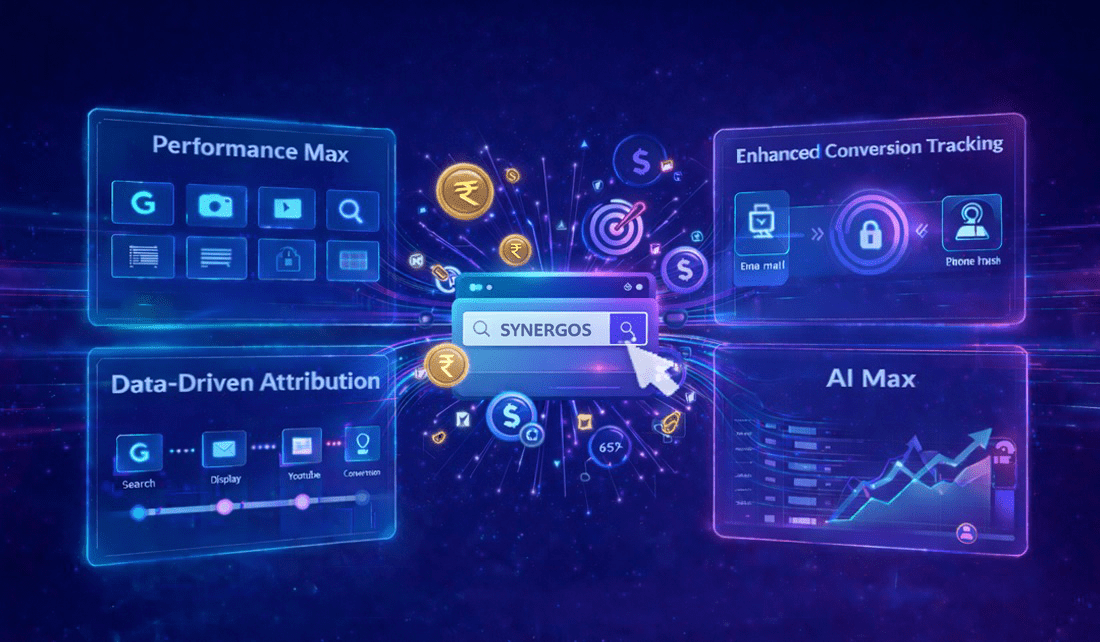
3 PPC Myths Holding You Back in 2026 (And What Works Instead)
18 Feb 2026 / Performance Marketing
Paid search isn’t dying; it’s evolving. Between AI taking a central role, privacy changes reshaping targeting, and AI Overviews shifting where people click (or don’t), PPC has a new playbook in 2026. AI is shaping how ads are served. First-party data is no longer optional. And conversion journeys are longer than most dashboards admit.
Yet many PPC strategies are still built on assumptions that simply do not hold anymore.
Below are three myths that are costing performance and wasting budget, along with what actually works today.
Myth 1: Keywords are still the main driver of PPC performance
Keywords still exist, but they are no longer primary decision-makers.
In 2025 and 2026, Google Ads increasingly rely on contextual signals such as device, location, historical behavior, and inferred intent to decide ad eligibility and placement. Keyword text is now only one signal among many.
What is happening now:
- AI Overviews and Search Generative Experience reduce visibility for generic keyword targeting
- Ads are served based on intent prediction, not exact phrasing
- Broad match combined with audience and contextual signals often outperforms tight keyword lists
What works instead:
- Intent-based keyword themes instead of exhaustive lists
- Audience layering to guide AI decision making
- Context-aware creative that matches user state, not just query
Myth 2: First-party data is helpful but not critical
This belief stopped being safe the moment privacy changes accelerated.
With third-party cookies losing reliability, Google has openly positioned first-party data as a core optimisation signal. In 2025, Google lowered Customer Match audience requirements to as few as 100 users, making first-party strategies viable even for smaller advertisers.
What is changing:
- First-party data directly influences bidding and learning stability
- Accounts with clean data learn faster and fluctuate less
- Weak signals force AI to optimise toward poor proxies
What works instead:
- Customer Match lists built from real users
- Server-side tracking to reduce signal loss
- Enhanced conversions to improve match accuracy
- Integrate your CRM so bidding decisions are guided by qualified leads and real revenue, not surface-level signals. (Revised: Bring CRM data into your bidding strategy so platforms learn what real success looks like, from qualified leads through to revenue.)
Myth 3: Automation will fix a weak strategy
Automation is now the default. Performance Max, smart bidding, and AI-driven creative assembly dominate modern accounts.
But automation does not replace strategy. It amplifies it.
Google has repeatedly stated that automation optimises toward the signals and goals advertisers provide, not toward undefined success.
Why this myth persists:
- Automation feels like a shortcut
- Early performance gains hide deeper inefficiencies
- Platforms encourage adoption faster than readiness
What works instead:
- Clear business-aligned conversion goals
- Strong first-party and CRM signals
- Clean tracking and stable measurement
- Human direction focused on intent and outcomes
Quick PPC reality check for 2026
Before increasing spend, ask:
- Are we feeding AI clean first-party signals?
- Are Customer Match and CRM integrations active?
- Is targeting built around intent and context, not volume?
- Are we measuring revenue and quality, not just clicks?
- Is automation amplifying strategy or replacing it?
Wrap Up
PPC in 2026 is not about mastering settings or expanding keyword lists. It is about giving platforms the right signals so AI can make better decisions at scale.
At Synergos, we help brands modernise PPC strategies around intent, first-party data, and clean signal flow. If your current setup still looks keyword-heavy and signal light, it may be time to rethink how it works.
To learn more about how we approach modern PPC, partner with Synergos.
Other Post
Content Optimisation Vs LLM Optimisation
20 Jul 2026 / Search Engine Optimization
B2B Influencer Marketing: The Overlooked Growth Lever B2B Brands Need
25 May 2026 / Digital Marketing

5 Best Practices to Supercharge Your Landing Pages
27 Apr 2026 / Performance Marketing
Found us interesting?
Let's discuss how Synergos can better your brand! Fill in your details or call us and we'll come up with a strategy that will help your brand stay on top of people's minds.