

 Blo
Blo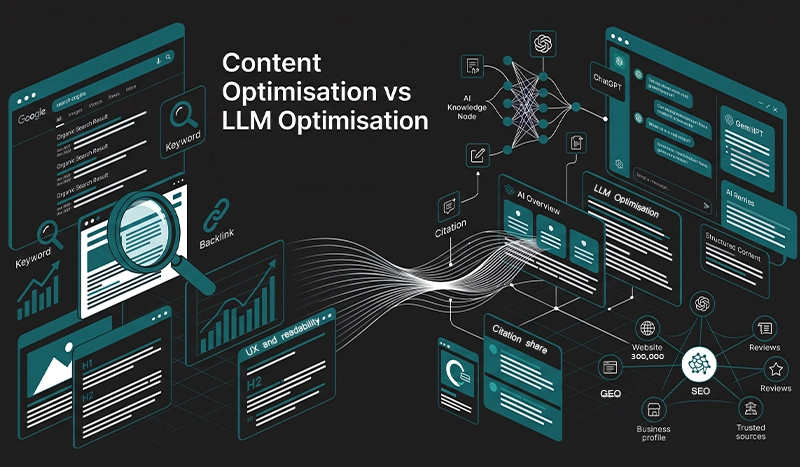
Content Optimisation Vs LLM Optimisation
20 Jul 2026 / Search Engine Optimization
Somewhere in the last three years, marketing quietly grew a new set of rules. SEO now shares a desk with GEO and AEO, and half the internet still treats “content optimisation” as a synonym for SEO. It never was. Content optimisation is the umbrella; SEO is one pillar under it, alongside editorial quality, readability, conversion design, and accessibility. LLM optimisation is a separate discipline again, a retrieval system reading the same page and asking a different question. Not where should this rank, but is this the fact I quote. Collapse content optimisation down to SEO alone, and three other audiences go unserved while you polish the one that only gets you a click.
Terms, Defined
| Term | What it means |
|---|---|
| SEO | Improves ranking position and click-through rate on traditional search results through keywords, technical structure, and backlinks. |
| GEO | Generative Engine Optimisation. Structuring content so generative AI systems retrieve and cite it inside a synthesised answer. |
| AEO | Answer Engine Optimisation. A layer inside GEO focused specifically on winning the exact fact or paragraph an engine quotes as its answer. |
| AI Overview (AIO) | Google’s AI-generated summary that appears above organic results on the results page. A product surface, not a discipline. |
| RAG | Retrieval Augmented Generation. The process by which an AI system fetches relevant documents at query time and grounds its answer in them. |
| Citation share | The percentage of AI-generated answers on a topic that mention or cite a given brand. The LLM optimisation equivalent of rank. |
Content Optimisation Was Never Just SEO
- Editorial quality and E-E-A-T. Accuracy, original reporting, author credentials, cited sources. The layer Google’s own quality raters have scored long before AI Overviews existed.
- UX and readability. Heading hierarchy, scannability, reading level, page speed. What keeps a human on the page long enough to act, not just rank.
- Conversion design. Calls to action, funnel alignment, on-page persuasion. SEO earns the visit; content optimisation decides what the visit becomes.
- Accessibility and multimedia. Alt text, captions, transcripts, video and infographic formats that widen who can use the content at all.
- SEO. Keyword targeting, on-page structure, backlinks. One pillar among five, not the whole building.
Where LLM Optimisation Diverges
- Citation frequency over ranking position. The unit of success is a fact, not a URL.
- Entity consistency across every surface. Not just the owned website; listings, reviews, and profiles too.
- Extractability. Can a paragraph be lifted whole into a generated answer?
- Shared floor. Both still depend on crawlable, well-structured, genuinely useful content. Neither replaces that requirement; it just adds to it.
The Comeback Nobody Modelled
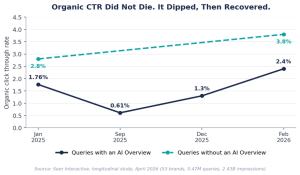
Most 2025 advice told you organic clicks were flatlining for good. They were not; well, not exactly. Seer Interactive’s April 2026 longitudinal study, tracking 53 brands, 5.47 million queries and 2.43 billion impressions, recorded organic click-through rate on AI Overview queries bottoming out at 1.3% in December 2025, then climbing 85% to 2.4% by February 2026. Queries without an AI Overview rose too, from 2.8% to 3.8% over the same window. Nobody’s clicks are dying. The two search experiences are simply splitting into different economies, and the gap between them, not the panic headline, is what your traffic forecast should be built on.
The llms.txt Myth
If “add llms.txt” is sitting on your content calendar this quarter, pause. At Google’s Search Central Deep Dive event in July 2025, Gary Illyes, analyst at Google Search Relations, confirmed on record that Google does not support llms.txt and has no plans to; John Mueller, Search Advocate at Google, separately compared it to the long-abandoned keywords meta tag. SE Ranking’s own analysis of roughly 300,000 domains found llms.txt adoption sitting at 10.13%, with no statistical link to how often a domain gets cited by AI systems, and among the 50 most AI-cited domains in their sample, only one had the file at all. Ship it if you want a tidy, low-cost artefact for the agentic browsing tools that do check for it; Chrome’s Lighthouse now audits for it, but budget it as housekeeping, not as a citation lever.
Trust Is the New Backlink
Entity and reputation signals are quietly doing the work backlinks used to do. A March 2026 study commissioned by Trustpilot and run by Seer Interactive, analysing over 800,000 AI-generated responses across ChatGPT, Gemini, Perplexity, and Google AI Mode, found brands with no active review profile were cited in roughly 1% of relevant answers. Simply establishing a presence lifted that figure to 53.5%, and brands with 80 or more reviews under active management reached 75.3%. Separately, Yext’s analysis of 17.2 million AI citations across ChatGPT, Perplexity, Gemini, and Claude found that verified, structured, directly distributed brand data, business listings, and knowledge panels among them accounted for 54.53% of all distinct citation sources, more than any other single category. Reputation infrastructure is now a ranking factor for a system that has no ranking page to check.
The Synergos Take
- Run content optimisation as one system, not five checklists. Editorial quality, UX, accessibility, conversions, and SEO should share a single brief.
- Write the answer first, then the explanation. Extractable text gets cited; buried text gets neither ranked nor quoted.
- Keep brand facts identical everywhere. Site, listings, reviews, social bios. Consistency is a trust signal AI systems weigh directly.
- Track citation shares alongside rank. A page can hold position one and still be invisible inside the generated answer.
- Skip the llms.txt panic. Spend that hour earning a review instead. The data says it travels further.
The brands winning in 2026 are not choosing between the two disciplines. They are running one content operation that happens to feed two audiences at once: people and the models people now ask first.
Sources
- GEO: Generative Engine Optimization, KDD ’24, ACM Digital Library
- Seer Interactive, AIO Impact on Google CTR: 2026 Update
- Search Engine Land, on Gary Illyes and llms.txt, July 2025
- SE Ranking, LLMs.txt: Why Brands Rely On It and Why It Doesn’t Work
- Trustpilot / Seer Interactive, brand citation study, PR Newswire, May 2026
- Yext, How ChatGPT, Perplexity, Gemini and Claude Decide What to Cite
Other Post
B2B Influencer Marketing: The Overlooked Growth Lever B2B Brands Need
25 May 2026 / Digital Marketing

5 Best Practices to Supercharge Your Landing Pages
27 Apr 2026 / Performance Marketing
The Content Scaling Paradox: Why More Content Delivers Less Visibility in 2026
16 Mar 2026 / Performance Marketing
Found us interesting?
Let's discuss how Synergos can better your brand! Fill in your details or call us and we'll come up with a strategy that will help your brand stay on top of people's minds.